
Mantra
A mantra is a word, syllable or short phrase repeated in order to gather attention. The practice comes from the Vedic texts of India and appears in similar form in almost every tradition of practice.
A word is always to hand
No object, no posture, no quiet needed. You carry a single word with you and can use it in a queue as easily as in a meeting.
It occupies the channel
The inner commentary cannot be switched off. It can be occupied — and a repeated word occupies exactly the place where it otherwise runs.
The return is built in
You notice at once when the word is gone. That makes the practice self-correcting: it signals its own interruption.
What mantra practice is
A mantra is a word, syllable or short phrase that is repeated — aloud, whispered or silently. The purpose is unspectacular: attention gets something to hold on to, and something you always have with you.
For an app like this one, mantra practice is interesting for a particular reason. It is the only concentration technique that is completely invisible — no posture, no closed eyes, no quiet place. Repeating a word silently works on a crowded bus.
Origins
The roots lie in India, in Vedic texts of the second millennium BCE. What is remarkable is how independently the technique appears everywhere: Buddhism in several forms, Christianity in a short prayer matched to the breath, Islam in the repetition of divine names.
In the West the technique spread in secular form in the 1960s and 1970s, with considerable marketing. The medical research of the same period showed something the commercial providers were reluctant to hear: the measurable effects did not depend on the particular word.
Key figures in the Friendly Pings
This is the group with the fewest names: these deep dives almost entirely describe techniques attributed to no single person.
Pema Chödröngeboren 1936
Amerikanische Nonne in der tibetischen Tradition. Ihr Begriff des Bleibens im Unbehagen, statt sofort davor auszuweichen, prägt die Pings, die nicht versprechen, dass ein Gefühl gleich vorbei ist.
Image: cello8 · CC BY-SA 2.0 · Wikimedia Commons
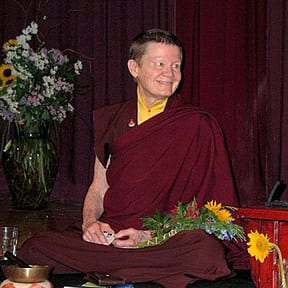

This selection follows the app, not the tradition: these are the people actually named in the deep dives of the Friendly Pings, ordered by how often. Centuries of practice cannot be represented by a handful of names, and that is not the claim here.
What that looks like
The whole text already sits on your lock screen. Tap it and you land here — the deep dives scroll.
- Your Friendly Ping
Today, 07:15
I choose one word as my anchor right now: peace, here, still.
Deep DiveThe use of a single word or syllable as an anchor for awareness is among the oldest and most universal contemplative techniques. In Hindu practice, a bija mantra (seed syllable) — 'Om,' 'Ram,' 'Shrim' — is chosen for its vibrational resonance and association. In Christian hesychast practice (Gregory Palamas, 14th century), the Jesus Prayer was gradually condensed: from a sentence, to a phrase, to a single word, then to breath, then to silence. In Transcendental Meditation, the personal mantra functions as a conditioned cue for the state of restful alertness. Psychologically, a chosen anchor word works through state-dependent access: the word summons the quality of awareness associated with practice, the way a melody can instantly return you to a specific mood. To choose the word is already the beginning of the return.
- Your Friendly Ping
Today, 09:40
I repeat 'So Hum' silently with my next three breaths — I am that.
Deep Dive"So Hum" is a classical mantra from India's Vedic tradition, meaning roughly "I am That" — an affirmation of the unity between the individual self (Atman) and universal being (Brahman). The syllables follow the natural sound of the breath: "So" on the inhale, "Hum" on the exhale. The breath itself becomes a silent prayer that gathers the mind and anchors it in the present.
- Your Friendly Ping
Today, 12:30
I return to my focus the way I return to breath in meditation.
Deep DiveThis instruction imports a core feature of meditation practice into daily work: the concept of return. In Vipassana and samādhi training, the instruction when the mind wanders is always the same — notice the wandering, without judgment, and return. Not once or twice but hundreds of times in a single sitting. The return is the practice, not the sustained staying. Pema Chödrön writes: 'The ability to stay just a moment longer than we usually do — that is what gives our practice depth.' Applied to work, this means that distraction is not failure: it is the normal condition of a mind. What matters is not how long attention lasts undisturbed but how quickly and cleanly it is recovered — the same quality as the meditator who returns to the breath.
What these pings aim at
Bring mindfulness into the middle of your life. Just try it.
Try it