
Sufism
Sufism is the mystical current of Islam, which emerged in the eighth and ninth centuries out of ascetic movements. Its practices include the repeated speaking of divine names and a form of gratitude that runs through the day.
- Your Friendly Ping
Today, 07:15
Don't read it. Just do it.
“I say Alhamdulillah right now for one specific thing in this moment.”
Deep DiveMore"Alhamdulillah" ("all praise is due to God") is, in Islam, an expression of gratitude in every moment — in ease and in hardship alike. Gratitude here is not a reaction to good circumstances but a baseline posture that opens the eyes to what has been given at all. Positive-psychology research confirms what the tradition long knew: consciously naming gratitude shifts attention from lack to abundance.
Ping done - Your Friendly Ping
Today, 09:40
Don't read it. Just do it.
“I begin the day with one breath of gratitude for being here.”
Deep DiveMoreThe Sufi poet Rumi opens the Masnavi with the image of the reed flute crying from separation — the longing for origin that inheres in every breath. In Islamic practice, the Fatiha, recited at the opening of every cycle of prayer, begins with 'Alhamdulillah' — all praise belongs to God. The morning, in Sufi understanding, is a small resurrection: each waking is an unrequested gift that was not guaranteed. The Persian poet Hafiz writes of being 'astonished' (hairān) at receiving existence again. This is not obligation but orientation: beginning the day not with agenda but with the recognition that existence itself — breath, light, warmth — is already the thing. One breath of gratitude before the day names itself.
Ping done - Your Friendly Ping
Today, 12:30
Don't read it. Just do it.
“I let myself be quietly pulled toward what I truly love.”
Deep DiveMore'Let yourself be silently drawn by the strange pull of what you really love,' wrote Rumi. 'It will not lead you astray.' There are things you do so completely that time disappears — no future to reach for, no past to carry, only this. Psychologists later named that state flow and found it among the surest sources of human happiness. But you knew it long before it had a name: as a child it was simply what you did, for hours, for no reason at all. Growing up, it gets buried under schedules and to-do lists. It is subtler now — not gone. Listen inward and you can still feel the pull. That is the direction your life is quietly asking you to go.
Ping done
Gratitude independent of circumstance
Shukr is not a reaction to good conditions but a baseline that is practised even when little speaks for it.
Fixed points in the day
Before eating, on waking, at the first breath: the formulas hang on moments that occur daily anyway and therefore require no discipline.
Permission to follow the pull
What absorbs you so completely that time disappears counts here not as distraction but as a trace. You are allowed to be drawn by it.
What Sufism is
Sufism is not a separate religion or a splinter but the mystical inside of Islam: the attempt not merely to believe in nearness to the divine but to experience it.
What it contributes to everyday life is remarkably concrete. First is gratitude, built in a particular way: as a formula spoken many times a day, each time for something specific. That is not ritualism but precisely the mechanism — attention is redirected by being redirected regularly.
The second element is longing. Its most famous image is the reed flute crying because it was cut from the reed bed — the separation is the reason for the sound.
Origins
The beginnings lie in the eighth and ninth centuries, among ascetics who set a deliberately plain way of living against the growing wealth of the Islamic empires. The twelfth and thirteenth centuries are considered its flowering, producing both the great orders and the poetry that carried Sufism far beyond Islam — its greatest name, Jalal ad-Din Rumi, is still counted among the most widely read poets in the English-speaking world.
A note of caution belongs here: Western reception has taken mostly poetry from this tradition while dropping its religious frame, and some of the most popular quotations are free renderings with no counterpart in the original. These pings therefore stay with practices — formulas, moments, stances — rather than quotations.
Key figures in the Friendly Pings
One voice appears above all in these deep dives — alongside practices that are attributed to no single person.
Rumi1207–1273
Persischer Dichter und Sufi. Sein Gedicht vom Gästehaus — jedes Gefühl ist ein Gast, kein Bewohner — steht wörtlich hinter einem der meistgenutzten Pings dieser Bibliothek.
Image: Hossein Behzad · Public domain · Wikimedia Commons
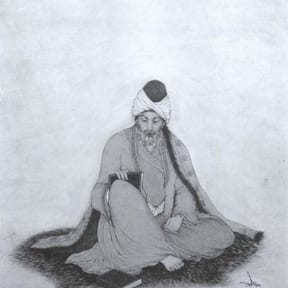

This selection follows the app, not the tradition: these are the people actually named in the deep dives of the Friendly Pings, ordered by how often. Centuries of practice cannot be represented by a handful of names, and that is not the claim here.
What these pings aim at

Pause in the middle of your day — and move on with more clarity
Bring mindfulness into the middle of your life. Just try it.